

If you’re a government employee in Pakistan — or getting ready to become one — figuring out exactly what you’ll take home each month can feel more complicated than it should be. Between basic pay, ad hoc relief allowances, house rent, medical allowance, and this year’s structural changes to the pay scale itself, the numbers on your payslip rarely match what you expected. This guide breaks down the BPS Pay Scale Chart 2026 in plain language: what changed in Budget 2026-27, how each BPS grade is affected, what allowances get added on top of basic pay, and how to work out your real take-home salary. Whether you’re a serving federal employee, a provincial government worker, or a candidate preparing for a government job, this article gives you a complete, easy-to-follow picture of Pakistan’s revised pay structure for 2026.
What Is the BPS Pay Scale Chart 2026?
The Basic Pay Scale (BPS) system is the salary structure used by the Government of Pakistan to pay federal and provincial employees. It runs from BPS-1 (the lowest grade, covering support staff such as Naib Qasid and Chowkidar) up to BPS-22 (the most senior civil service positions, such as Federal Secretary). Every government job in Pakistan — federal, provincial, or in many autonomous departments — is anchored to one of these 22 grades, and your grade determines your basic pay, your annual increment, your allowances, and eventually your pension.
The BPS Pay Scale Chart 2026 refers to the updated salary structure that took effect after the Federal Budget 2026-27, presented by Finance Minister Muhammad Aurangzeb in the National Assembly on June 12, 2026. This year’s chart is different from a typical annual update because it doesn’t just add a percentage on top of last year’s basic pay — it restructures basic pay itself.
Under the Revised Basic Pay Scales 2026 (RBPS-2026), the government permanently merged two previously separate ad hoc relief allowances — the 15% ARA-2022 and the 10% ARA-2025 — directly into basic pay. Combined, this raises the basic pay figure for every grade by roughly 25% before the new 7% Ad Hoc Relief Allowance (ARA-2026) is even calculated. On top of that, a fresh 7% relief allowance was announced for all BPS-1 to BPS-22 employees, along with a 50% increase in conveyance allowance and a 15% Disparity Reduction Allowance (DRA) for specific employee categories, effective July 1, 2026.
In short: 2026 isn’t just a small cost-of-living bump. It’s the first genuine basic pay scale revision since 2022, and it changes the base figure that your pension, house rent allowance, and future increments will be calculated on for years to come.
Why the BPS Pay Scale Chart 2026 Matters
A lot of employees skim past the technical details and focus only on the headline “7% increase” figure. That’s a mistake, and here’s why it matters to look deeper.
- Pension is calculated on basic pay, not gross salary. If your basic pay rises structurally (as it has under RBPS-2026), your eventual pension rises with it — permanently, not just for one budget cycle.
- Allowances are often a percentage of basic pay. A higher basic pay base means house rent allowance, medical allowance, and other basic-pay-linked benefits also increase.
- Take-home pay depends on more than one number. Between the merger effect, the new 7% relief allowance, the conveyance increase, and revised income tax slabs for higher grades, your real monthly gain can look very different from a simple “7%” headline.
- Officers in BPS-17 and above face different income tax treatment. Budget 2026-27 revised tax slabs for annual incomes above Rs 2.2 million, which changes net take-home pay independent of the salary increase itself.
Understanding the full mechanism — not just the percentage — is the only way to accurately estimate your revised salary, plan your household budget, or compare a government job offer against a private sector one.
BPS Pay Scale Chart 2026: Grade-by-Grade Overview
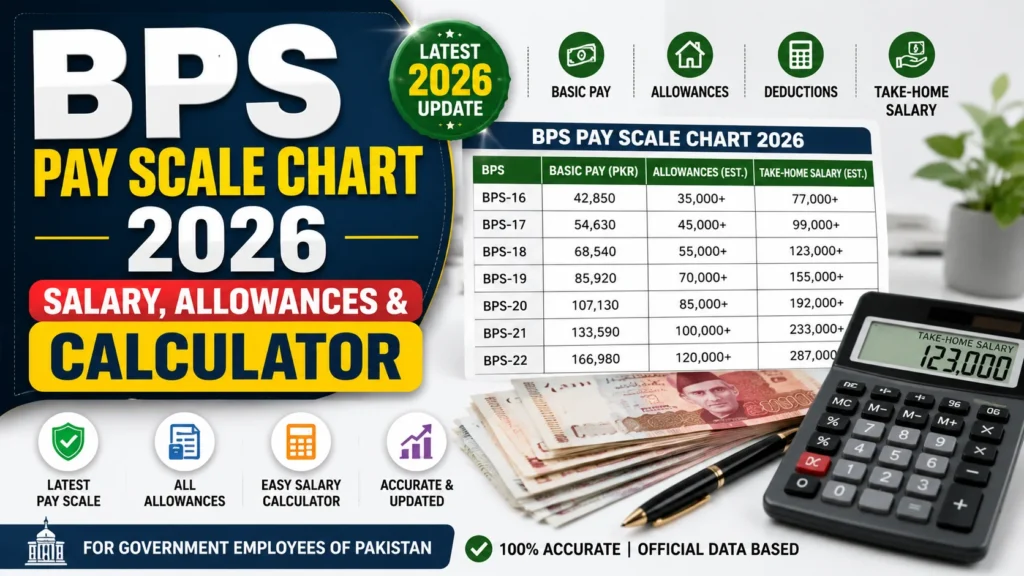
The table below shows the pre-merger 2022 basic pay minimum for each grade, alongside the estimated post-merger RBPS-2026 minimum basic pay and the additional 7% ARA-2026 relief allowance. These figures reflect budget speech announcements and are widely used estimates pending the official Finance Division gazette notification, so treat them as a planning guide rather than your final payslip figure — always confirm with your Drawing and Disbursing Officer (DDO) once the notification is issued.
| BPS Grade | 2022 Basic Pay (Min) | RBPS-2026 Est. Basic Pay (Min) | ARA-2026 (7%) | Typical Posts |
|---|---|---|---|---|
| BPS-1 | Rs 10,258 | Rs 12,823 | Rs 898 | Naib Qasid, Sweeper |
| BPS-5 | Rs 12,253 | Rs 15,316 | Rs 1,072 | Junior Clerk, Telephone Operator |
| BPS-7 | Rs 13,634 | Rs 17,043 | Rs 1,193 | Storeman, Junior Patrol Officer |
| BPS-9 | Rs 15,334 | Rs 19,168 | Rs 1,342 | Assistant Store Keeper, Head Clerk |
| BPS-11 | Rs 17,397 | Rs 21,746 | Rs 1,522 | LDC, Stenographer |
| BPS-14 | Rs 21,293 | Rs 26,616 | Rs 1,863 | Senior Assistant, Head Accountant |
| BPS-16 | Rs 28,227 | Rs 35,284 | Rs 2,470 | Inspector, Entry-Level Officer |
| BPS-17 | Rs 40,036 | Rs 50,045 | Rs 3,503 | Section Officer, Assistant (CSS) |
| BPS-18 | Rs 56,847 | Rs 71,059 | Rs 4,974 | Deputy Director, Deputy Manager |
| BPS-19 | Rs 80,660 | Rs 100,825 | Rs 7,058 | Director, Joint Secretary |
| BPS-20 | Rs 114,455 | Rs 143,069 | Rs 10,015 | Deputy Secretary, Additional DG |
| BPS-21 | Rs 162,395 | Rs 202,994 | Rs 14,210 | Additional Secretary |
| BPS-22 | Rs 225,000+ | Rs 281,250+ | Rs 19,688+ | Federal Secretary and senior posts |
A note on accuracy: these numbers are estimates built by applying the announced 25% RBPS-2026 merger effect to 2022 basic pay figures, then layering the 7% ARA-2026 on top. The Finance Division’s official grade-by-increment-stage notification was still pending as of this writing, so your actual figure — especially at higher increment stages within a grade — may differ. Provincial governments (Punjab, Sindh, KPK, Balochistan, AJK) also announce their own versions of the relief allowance and can differ slightly from the federal package, so a BPS-16 employee in Punjab and a BPS-16 employee in the federal government won’t necessarily see identical rupee figures.
At RozGhar, we publish well-researched guides to help job seekers and government employees make informed decisions. Along with this BPS Pay Scale Chart 2026, you can also explore our latest articles on Government Jobs in Pakistan, Pak Army Jobs 2026, Junior Software Development Jobs, Punjab Pay Scale, Sindh Pay Scale, KP Pay Scale, Balochistan Pay Scale, Government Allowances, and Pension Rules to stay updated with the latest official information.
Understanding the Full Salary Package: What’s Actually New in 2026
Most coverage of the government salary increase 2026 focuses only on the 7% figure, but the real package has five distinct components:
- 7% ARA-2026 — a fresh ad hoc relief allowance applied on top of the revised (post-merger) basic pay, flat across all grades from BPS-1 to BPS-22.
- RBPS-2026 merger (~25%) — the structural absorption of the 2022 (15%) and 2025 (10%) ad hoc allowances into basic pay itself.
- 15% Disparity Reduction Allowance (DRA) — available only to specific employee categories identified by the Finance Division, not a universal benefit.
- 50% increase in conveyance allowance — applied to the existing conveyance rate per grade, not to total salary.
- 7% pension increase — for existing retirees, calculated on current net pension.
The government’s own logic for holding the headline figure at 7% (compared to last year’s 10–15% differentiated increase) traces back to Pakistan’s IMF Extended Fund Facility, which requires a primary surplus target of roughly 2% of GDP. Salary expenditure directly competes with that fiscal target, which is why officials paired a modest headline percentage with a larger, less visible structural change — the basic pay merger — that has a bigger long-term financial impact, especially on pensions.
How to Calculate Your Take-Home Salary in Pakistan (Step-by-Step)
Your take-home salary is what actually lands in your bank account after allowances are added and deductions (income tax, pension contribution, and any other withholdings) are subtracted. Here’s the calculation sequence that avoids the most common mistakes:
Step 1: Identify your current basic pay. Use the exact figure labeled “Basic Pay” on your payslip — not gross pay, not last year’s take-home figure.
Step 2: Apply the RBPS-2026 merger. If your department has issued the revised scale, use that figure directly. If not, apply the estimated 25% uplift as a placeholder for planning purposes only.
Step 3: Add the 7% ARA-2026. Multiply your revised basic pay by 0.07. This is your new relief allowance line item.
Step 4: Add house rent allowance, medical allowance, and conveyance allowance. These vary by department, city, and grade — conveyance allowance specifically rose by 50% over its previous rate in Budget 2026-27.
Step 5: Check DRA eligibility. The 15% Disparity Reduction Allowance doesn’t apply to everyone — check with your department if your cadre qualifies.
Step 6: Subtract income tax (if applicable). For most BPS-1 to BPS-16 employees, whose annual gross income falls below Rs 2.2 million, income tax slabs were unchanged in 2026-27. Grade-17 and above officers with higher annual income should apply the revised, lower tax rates introduced in Finance Bill 2026-27.
Step 7: Subtract any pension or benevolent fund contributions, which are typically a small fixed percentage of basic pay.
Gross Salary = Basic Pay + All Allowances
Net (Take-Home) Salary = Gross Salary − Income Tax − Other Deductions
Worked Example
Take a BPS-17 Section Officer with a pre-merger basic pay of roughly Rs 40,036. After the RBPS-2026 merger effect, the estimated revised basic pay rises to around Rs 50,045. Adding the 7% ARA-2026 (about Rs 3,503) brings basic-pay-linked income to roughly Rs 53,548 before house rent, medical, and conveyance allowances are added. Once those allowances are included, a BPS-17 officer’s gross monthly salary typically lands well above Rs 90,000–100,000, depending on posting city and department-specific allowance rates. Because most BPS-17 officers fall in the income tax bracket that saw a rate reduction in 2026-27, take-home pay also benefits slightly from lower withholding tax compared to the previous fiscal year.
Income Tax Changes That Affect Your Net Salary
Budget 2026-27 revised income tax slabs for four annual income brackets and removed the surcharge previously applied to very high earners. For most government employees in BPS-1 to BPS-16, whose annual salary sits below Rs 2.2 million, tax slabs were left unchanged — their real gain comes entirely from the salary and conveyance revisions. For BPS-17 and above, where annual gross income more commonly crosses that Rs 2.2 million line, marginal tax rates on the Rs 2.2–3.2 million and Rs 3.2–4.1 million brackets were both reduced, translating into a modest but real increase in monthly take-home pay beyond the salary increase itself. This is one reason two employees with a similar percentage salary increase can end up with noticeably different take-home gains once tax is factored in.
Pension Increase 2026: What Retirees Need to Know
Retired federal government employees receive a 7% increase in net pension, effective from the July 2026 payment cycle. The calculation is straightforward: take your current net monthly pension and add 7%. For example, a retiree drawing Rs 50,000 per month gains Rs 3,500, bringing the new monthly pension to Rs 53,500.
For employees still serving, the more significant long-term change isn’t this year’s 7% — it’s the RBPS-2026 basic pay merger. Since pension is calculated on your basic pay at the time of retirement, anyone retiring in FY2027 or later will retire on the higher, merged basic pay figure, permanently raising their monthly pension compared to someone who retired even a year earlier under the old scale. It’s worth noting that provincial pension increases don’t always match the federal rate — some provinces have historically set a lower percentage for their own retirees, so pensioners should confirm the applicable rate with their specific pension-disbursing authority.
BPS Allowances Explained: What Gets Added to Basic Pay
Understanding your allowances is just as important as understanding your basic pay, since allowances often make up a large share of gross salary, especially at lower and middle grades.
- House Rent Allowance (HRA): A percentage of basic pay, varying by city classification and grade, meant to offset accommodation costs.
- Medical Allowance: A fixed or percentage-based allowance covering routine medical expenses, revised periodically alongside basic pay scales.
- Conveyance Allowance: Covers commuting costs; this allowance specifically rose by 50% over its previous rate under Budget 2026-27.
- Adhoc Relief Allowance (ARA): Historically added as separate, non-consolidated allowances year over year; the 2022 and 2025 versions were merged into basic pay under RBPS-2026, while the 2023 and 2024 versions remain separate line items.
- Utility Allowance: A smaller fixed allowance intended to help with utility bills, applicable mainly to specific grades and departments.
- Executive Allowance: Applicable to select officer-cadre positions, often tied to specific departments or roles rather than a flat grade-wide rate.
Because several of these allowances are calculated as a percentage of basic pay, the RBPS-2026 merger effectively raises them too — even though the government didn’t announce a separate increase for each one individually.
Job Scope, Salary, and Demand Across BPS Grades
Government employment in Pakistan continues to attract strong demand, largely because of job security, structured career progression, and defined pension benefits — advantages that are harder to find in much of the private sector. A few patterns are worth knowing if you’re evaluating a government career path in 2026:
- BPS-1 to BPS-15 covers support staff, clerical roles, and junior technical positions. Entry is often through provincial or departmental recruitment tests, and starting basic pay is modest but grows steadily through annual increments.
- BPS-16 marks the entry point for many gazetted and inspector-level roles, often reached via departmental promotion or specific recruitment exams.
- BPS-17 is the standard entry grade for CSS (Central Superior Services) officers and many specialist positions filled through the Federal Public Service Commission (FPSC). It’s widely searched precisely because it represents the first true “officer” tier with meaningful allowances and career mobility.
- BPS-18 to BPS-20 covers mid-to-senior management roles — Deputy Directors, Directors, Deputy Secretaries — typically reached through time-based promotion combined with performance evaluation.
- BPS-21 and BPS-22 represent the most senior civil service tier, including Additional Secretaries and Federal Secretaries, usually reached only after decades of service.
Demand for government positions, particularly at BPS-16 and BPS-17, remains high every recruitment cycle, driven by the combination of a defined pay scale, allowances, and post-retirement pension — benefits that are explicitly protected and periodically revised through the annual budget process, as this year’s RBPS-2026 merger demonstrates.
Real-World Example: How the 2026 Revision Plays Out
Consider a BPS-16 Inspector with roughly nine years of service. Their pre-merger 2022 basic pay was in the range of Rs 28,227 at minimum stage, but with nine annual increments applied, their actual basic pay before the 2026 revision would have been considerably higher than the starting figure. Once the RBPS-2026 merger and 7% ARA-2026 are applied to that already-incremented basic pay, their monthly gain — combining basic pay, the conveyance increase, and unchanged allowances — typically runs into several thousand rupees a month, without even accounting for the compounding effect on their eventual pension. This illustrates why simply looking up the “minimum” figure for your grade in a chart isn’t enough — your actual increment stage matters just as much as your grade.
Minimum Wage and the Broader Salary Landscape in 2026
Alongside the BPS revision, the federal government also raised the minimum monthly wage to Rs 40,700, a 10% increase from the previous floor of Rs 37,000. This is relevant context for BPS-1 to BPS-4 employees, whose basic pay in early increment stages can sit below the minimum wage threshold — though their gross salary, once allowances are added, generally places them above that floor. The gap between the 10% minimum wage increase and the 7% federal salary increase reflects the government’s attempt to address wage pressure at the lowest income levels while staying within the fiscal limits set by Pakistan’s ongoing IMF programme commitments.
How to Access the Official BPS Pay Scale Chart PDF
For the most reliable, department-specific figures, always cross-check estimates against the official Finance Division notification, published on the Finance Division’s website once RBPS-2026 is formally gazetted. Provincial finance departments (Punjab, Sindh, KPK, Balochistan) separately notify their own applicable rates, so federal and provincial employees in the same nominal BPS grade may see different final figures. Your department’s Drawing and Disbursing Officer (DDO) is the most reliable point of contact for your exact, confirmed revised basic pay.
Frequently Asked Questions
What is the BPS Pay Scale Chart 2026?
It’s the revised government salary structure for Pakistan’s federal and provincial employees following Budget 2026-27, which merged two previous ad hoc allowances into basic pay (RBPS-2026) and added a further 7% relief allowance across BPS-1 to BPS-22, effective July 1, 2026.
How much salary does a BPS-17 officer receive in Pakistan in 2026?
Based on the revised structure, a BPS-17 officer’s basic pay at minimum stage is estimated at roughly Rs 50,000 after the RBPS-2026 merger, with gross monthly salary — including house rent, medical, and conveyance allowances — commonly reaching Rs 90,000 to over Rs 100,000 depending on posting city and increment stage. Exact figures depend on the official Finance Division notification.
Has the BPS salary increased in 2026?
Yes. Budget 2026-27 introduced a 7% Ad Hoc Relief Allowance for all BPS-1 to BPS-22 employees, on top of a structural ~25% basic pay increase from merging the 2022 and 2025 ad hoc allowances into basic pay under RBPS-2026.
How do you calculate take-home salary in Pakistan?
Add your basic pay to all applicable allowances (house rent, medical, conveyance, and any relief allowances) to get gross salary, then subtract income tax and any pension or fund contributions to arrive at your net take-home salary.
What allowances are included in BPS salary?
Common allowances include House Rent Allowance, Medical Allowance, Conveyance Allowance, Adhoc Relief Allowance, and — for select cadres — Utility Allowance, Executive Allowance, or the Disparity Reduction Allowance.
Is there an official BPS salary calculator?
Several finance and career websites offer unofficial salary calculators based on announced budget figures, but for a legally accurate figure, employees should confirm their revised basic pay with their DDO once the Finance Division’s official RBPS-2026 notification is issued.
Conclusion
The BPS Pay Scale Chart 2026 represents one of the more structurally significant salary revisions Pakistani government employees have seen in recent years — not because the headline 7% figure is dramatic, but because the underlying RBPS-2026 merger permanently raises the basic pay base that pensions, allowances, and future increments are built on. Whether you’re checking your own grade’s revised figures, planning for retirement, or simply trying to understand what changed this budget cycle, the key is to look past the percentage headline and understand the full package: the merger, the relief allowance, the conveyance increase, and the tax slab changes that apply above BPS-17. Bookmark the official Finance Division notification once it’s published, confirm your exact figures with your DDO, and use the calculation steps in this guide to estimate your revised take-home salary with confidence.
We hope this BPS Pay Scale Chart 2026 guide has helped you understand the latest salary structure, allowances, and take-home pay for government employees in Pakistan. At RozGhar, we are committed to providing accurate and up-to-date career, salary, and government job information. If you need any further details or have any questions, feel free to contact the RozGhar team—we’re always here to help.


Pingback: PPSC Roll Number Slip 2026 –Easy Download Guide & Checklist
Pingback: KPPSC Jobs 2026: Online Apply & Exam Guide
Pingback: Pakistan Air Force (PAF) Jobs 2026: Ultimate Guide
Pingback: Ultimate Sindh & KPK Police Jobs 2026 – Apply Fast
Pingback: BPSC Jobs 2026: Ultimate Guide to Apply & Success
Pingback: National Highway & Motorway Police Jobs 2026 – Secure Career
Pingback: Dolphin Police Jobs 2026 – Apply Online for Male & Female
Pingback: Civil Judge Jobs in Pakistan 2026 | Apply & Eligibility
Pingback: Health Dept Punjab Jobs 2026 – Latest Vacancies & Apply
Pingback: Pakistan Railways Jobs 2026 – Latest Vacancies & Apply
Pingback: STI Jobs Eligibility 2026 Age Limit, Qualification & Stipend