

Every year, thousands of law graduates and support-staff aspirants across Pakistan search for one thing: a secure, respected career inside the country’s judicial system. Whether you are eyeing a Civil Judge-cum-Magistrate (BS-17) post at the Lahore High Court, a clerical role in a district judiciary office, or a support-staff position like Naib Qasid or Driver, the process can feel confusing if you don’t know where to look or how to apply correctly.
This guide breaks down everything you need to know about Civil judiciary jobs in Pakistan 2026 — eligibility, application steps, required documents, exam patterns, salary expectations, and where the latest advertisements are published. If you’re serious about building a career in Pakistan’s justice system, this is the only guide you’ll need.
What Are Judiciary Jobs in Pakistan?
Judiciary jobs refer to government positions within Pakistan’s court system — from the Supreme Court of Pakistan and provincial High Courts (Lahore High Court, Sindh High Court, Peshawar High Court, Balochistan High Court) down to district and sessions courts across every province.
These roles fall into two broad categories:
- Judicial posts — Civil Judge-cum-Magistrate, Judicial Magistrate, Additional District & Sessions Judge — which require an LLB or LLM and Bar Council enrollment.
- Non-judicial / support posts — Assistant Registrar, Law Clerk, Stenotypist, Computer Operator, Naib Qasid, Bailiff, Driver, Chowkidar, and Sweeper — which range from Matric to Bachelor’s level qualifications.
You’ll find these opportunities advertised under many regional names — district judiciary jobs, KPK judiciary jobs, judiciary jobs in Punjab, or simply listed by district, such as civil judge jobs in Faisalabad, civil judge Bannu jobs, or district judiciary Charsadda jobs. They all follow the same core recruitment framework, even though each High Court or district office issues its own separate advertisement.
Why a Judiciary Job Is Worth Pursuing
A government job in the judicial sector isn’t just about a paycheck — it’s one of the most stable career paths available in Pakistan today. Here’s why:
- Permanent government status — pension, medical benefits, and job security that private-sector roles rarely match.
- Structured career growth — a Civil Judge can rise through the ranks to Senior Civil Judge, District & Sessions Judge, and eventually High Court judgeship.
- Respect and public service — judicial officers and court staff play a direct role in upholding the rule of law.
- Consistent hiring cycles — unlike many sectors, courts across Punjab, Sindh, KPK, Balochistan, and AJK regularly announce judiciary jobs 2026 vacancies as officers retire, transfer, or get promoted.
If you’ve been searching things like “judges vacancies in Pakistan” or “how much time civil judge vacancy come in Pakistan LHC,” the honest answer is: fairly often. Civil Judge recruitment drives happen almost every year in one province or another, and support-staff hiring at the district judiciary level happens even more frequently.
Eligibility Criteria and Key Requirements
Eligibility depends entirely on which post you’re targeting. Here’s a general breakdown:
For Civil Judge-cum-Magistrate (BS-17):
- LLB (Bachelor of Laws) from an HEC-recognized university
- Enrollment as an Advocate with the relevant Bar Council
- Age typically between 21–35 years (varies by High Court; relaxation applies for certain categories)
- Pakistani domicile of the relevant province
- Good moral character certificate, often required from the Bar Association
For Judicial Magistrate / Assistant Registrar posts:
- LLB or LLM depending on the specific advertisement
- Relevant experience may be preferred for senior roles
For clerical and support staff (Law Clerk, Stenotypist, Computer Operator, UDC/LDC):
- Intermediate or Bachelor’s degree
- Typing speed certificate (for Stenotypist and Computer Operator posts — this is where searches like “typing test regarding judiciary job” come from)
- Basic computer proficiency
For support roles (Naib Qasid, Driver, Bailiff, Chowkidar, Sweeper):
- Primary, Middle, or Matric qualification
- Valid driving license (for Driver posts)
- Physical fitness certificate in some cases
Because requirements shift from one High Court to another and even between districts (Bahawalpur, Khanewal, Jhelum, Kasur, Sheikhupura, Gujranwala, Mianwali, and dozens more each issue their own local ads), always read the official advertisement carefully before applying — never rely on secondhand information.
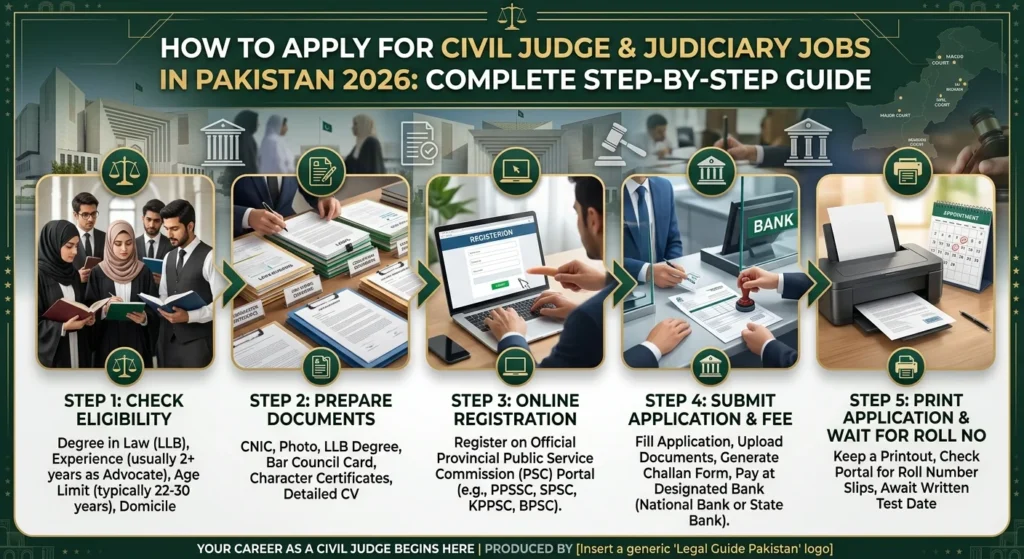
Step-by-Step: How to Apply for Civil Judge & Judiciary Jobs 2026
Here’s the practical process most candidates follow:
- Track official advertisements. Judiciary jobs are published in major newspapers (Jang, Dawn, Express) and on official High Court websites. Punjab positions typically route through the Lahore High Court’s recruitment portal, Sindh through the Sindh High Court, and similarly for KPK and Balochistan.
- Check the specific advertisement number. Recent examples include announcements like Advertisement No. 01/2026/CJM/R&E (judicial posts) and 02/2026/R&E (support staff) — each ad carries its own reference number, post breakdown, and deadline.
- Confirm your eligibility against the qualification, age, and domicile requirements listed for each post code.
- Prepare your documents, including:
- CNIC copy
- Educational certificates and transcripts
- Domicile certificate
- Bar Council enrollment certificate (for judicial posts)
- Recent passport-size photographs
- Experience certificates (where applicable)
- Fill out the application form — either through the online portal (where available) or by downloading and submitting a physical form to the relevant District & Sessions Judge office or High Court recruitment branch.
- Pay the application fee through the specified bank challan, if required.
- Submit before the deadline. Late submissions are almost never entertained in judiciary recruitment — courts are strict about cut-off dates.
- Prepare for the written test. Judicial posts usually involve a written law exam followed by an interview. Support staff posts may involve a relevant skills test (typing, computer literacy) plus a short interview.
- Check the roll number slip and results on the issuing court’s official notice board or website once released.
If your search brought you here through terms like “civil judge jobs advertisement KPPSC” or “civil judge jobs slybus” (syllabus), know that different provinces manage this differently — Punjab positions are largely handled directly by the High Court, while KPK’s civil judge and judicial magistrate recruitment often runs through the Khyber Pakhtunkhwa Public Service Commission (KPPSC). For a full walkthrough of that specific process, our guide on KPPSC jobs and how to apply online covers it step by step.
Job Scope, Salary, and Demand
Salary and scope depend heavily on the post and grade:
- Civil Judge-cum-Magistrate (BS-17): Starts in the BS-17 pay scale, with standard government allowances (house rent, medical, conveyance) and structured annual increments. For a broader look at how BS-17 and other government pay scales work, see our BPS pay scale chart 2026.
- Judicial Magistrate / Assistant Registrar: Similar BS-17 to BS-18 range depending on seniority and court.
- Clerical staff (Stenotypist, Computer Operator): Generally BS-11 to BS-16.
- Support staff (Naib Qasid, Driver, Chowkidar): BS-03 to BS-07.
Demand remains consistently strong. District judiciary offices across Punjab, Sindh, KPK, and Balochistan regularly announce vacancies as courts expand and staff retire or get promoted. Since law graduates in Pakistan have grown significantly in recent years, competition for judicial posts specifically has also increased — meaning strong exam preparation matters more than ever.
Why Job Seekers Choose ROZGAR for Judiciary Job Alerts
Finding the right advertisement at the right time is often the hardest part of this process — vacancies get published in scattered newspaper editions, buried on court websites, or shared late in local WhatsApp groups. This is exactly the gap ROZGAR fills.
At ROZGAR’s Government Jobs section, listings for district judiciary, High Court, and law-and-order sector recruitment are compiled and updated regularly, so you don’t have to chase multiple newspapers or scattered PDFs. You can also browse our Forces & Law Jobs category for related public-sector legal and enforcement opportunities.
If you’d rather have opportunities come to you, explore all current job listings on ROZGAR or set up alerts through the job dashboard so new judiciary advertisements reach you as soon as they’re published.
How to Prepare: Free and Paid Resources
Whether you’re applying for a judicial post or a clerical one, preparation matters.
For Civil Judge / Judicial Magistrate written tests:
- Review Pakistan’s civil and criminal procedure codes (CPC, CrPC), the Constitution of Pakistan, and relevant substantive laws
- Practice past papers from previous High Court judicial exams
- Join structured judiciary exam preparation academies (many operate in Lahore, Karachi, and Peshawar)
- Mock interviews with senior advocates or judicial coaching centers
For clerical and support posts:
- Typing practice for Stenotypist/Computer Operator roles
- Basic computer literacy courses (MS Office, data entry)
- General knowledge and Pakistan studies review for the written screening test, which many district courts still use
General exam-pattern guidance:
Since a large share of provincial recruitment (including some judiciary-linked posts) is coordinated through public service commissions, our detailed PPSC written test syllabus and preparation guide is a useful reference for understanding how these government exams are typically structured, even when the recruiting body differs.
For candidates applying through Punjab’s provincial commission route, the PPSC jobs 2026 apply online guide and PPSC roll number slip 2026 pages walk through the online application and admit-card process in detail. Sindh-based applicants can check our SPSC jobs Sindh complete guide for that province’s equivalent process.
Real-World Examples: How Judiciary Recruitment Actually Works
To make this less abstract, here’s how a typical cycle plays out:
Example 1 — Lahore High Court: The Lahore High Court periodically issues combined advertisements covering both judicial posts (Civil Judge-cum-Magistrate, BS-17) and non-judicial support staff (Cook, Bearer, Sweeper, Frashman) in a single notification. Applicants must select the correct advertisement number for their post category, since judicial and non-judicial applications are processed through entirely separate channels.
Example 2 — District & Sessions Judge offices: Smaller recruitment drives — for example, in Dera Ismail Khan, Rajanpur, or Karachi’s district courts — typically focus on support roles like Naib Qasid, Bailiff, Driver, and Computer Operator, with qualifications ranging from Primary to Matric. These ads are published in regional newspapers and often have shorter, stricter deadlines than High Court-level judicial recruitment.
Example 3 — Provincial High Courts (Sindh, Peshawar, Balochistan): Each High Court publishes its own recruitment notices independently — you can review the Sindh High Court’s official advertisements and current vacancy notices directly on sindhhighcourt.gov.pk as one authoritative reference point for how these announcements are formatted and updated.
These examples show why it’s risky to rely only on old search results or outdated forum posts about “civil judge jobs 2019” or “district judiciary jobs 2018” — recruitment numbers, post codes, and eligibility details change every cycle. Always verify against the current year’s official advertisement.
Future Career Opportunities in Pakistan’s Judiciary
A career in the judiciary isn’t a dead end at entry level — it’s a long-term ladder:
- Civil Judge → Senior Civil Judge → Additional District & Sessions Judge → District & Sessions Judge — a well-defined promotion path based on seniority, performance, and judicial training.
- Judicial Academy training — officers regularly attend provincial Judicial Academies for continuous professional development, which also opens pathways to specialized tribunals and commissions.
- Support staff progression — clerical and administrative staff can move up through departmental promotion quotas into higher BS grades over time.
- Cross-sector mobility — experience in judicial administration is highly valued if you later move into legal research, policy roles, or law-related public sector positions.
For law graduates specifically, this career path offers something increasingly rare in Pakistan’s job market: a clear, merit-based progression system with long-term stability.
Frequently Asked Questions
What is the eligibility criteria for Civil Judge jobs in Pakistan 2026?
Candidates need an LLB from an HEC-recognized university, enrollment as an Advocate with the relevant Bar Council, provincial domicile, and must fall within the age bracket specified in the advertisement (usually 21–35 years, with relaxation for certain categories).
How can I apply online for Civil Judge and judiciary jobs 2026?
Check the official High Court or district judiciary website for the current advertisement, download or fill the application form as instructed, attach required documents, pay the application fee if applicable, and submit before the deadline stated in the ad.
What is the salary of a Civil Judge in Pakistan?
A Civil Judge-cum-Magistrate typically starts at BS-17, which includes base pay plus standard government allowances like house rent and medical. Exact figures vary slightly with each annual budget revision.
Is LLM required for Civil Judge jobs, or is LLB enough?
An LLB is generally sufficient for Civil Judge and Judicial Magistrate posts. LLM is not usually mandatory, though it can be an advantage for certain senior or specialized judicial roles.
How many vacancies are usually announced for judiciary jobs each year?
This varies significantly by province and district — ranging from a handful of Civil Judge posts in a single High Court advertisement to dozens of support-staff vacancies across multiple district judiciary offices in a single recruitment cycle.
What is the difference between a Civil Judge and a Judicial Magistrate?
A Civil Judge primarily handles civil disputes, while a Judicial Magistrate deals with criminal cases. In Pakistan’s lower judiciary, many officers hold a combined designation — Civil Judge-cum-Magistrate — and exercise both civil and criminal jurisdiction depending on their posting.
Final Thoughts: Your Next Step Toward a Judiciary Career
Judiciary jobs in Pakistan — whether it’s a Civil Judge post at the Lahore High Court, a clerical role in district judiciary Charsadda, or a support-staff position in Faisalabad, Bannu, Kasur, or Sheikhupura — remain one of the most stable and respected career paths available in the public sector. The process rewards preparation: knowing exactly where advertisements are published, understanding your eligibility, and submitting a complete, error-free application before the deadline.
Don’t let scattered newspaper ads and outdated online posts slow down your search. Explore the latest government job openings on ROZGAR and stay ahead of every judiciary recruitment cycle in 2026. If you’re an employer or court office looking to reach qualified candidates directly, you can also post a job on ROZGAR to connect with serious applicants.
Book your seat in ROZGAR’s advanced job-alert network today and never miss a Civil Judge or judiciary job advertisement again.