
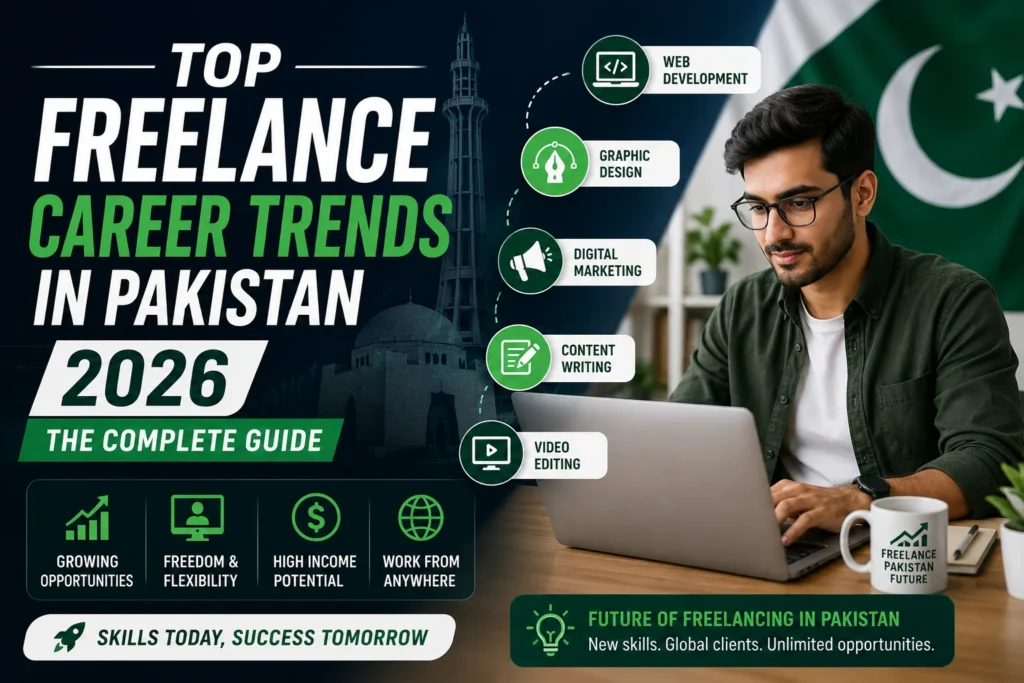

Freelancing in Pakistan has stopped being a “side hustle” and turned into a real career path. If you’ve been scrolling through online jobs in Pakistan or wondering whether freelance work in Pakistan is actually worth your time in 2026, the short answer is yes — but only if you know where the market is heading. This guide breaks down the biggest freelance career trends in Pakistan 2026, the skills that are actually paying, how much you can realistically earn, and the exact steps to start — whether you’re a student in Lahore, a stay-at-home parent in Gujranwala, or a fresh graduate in Karachi looking for remote job online in Pakistan options. Let’s get into it.
What Is Freelancing in Pakistan in 2026?
Freelancing simply means offering your skills — writing, design, development, marketing, virtual assistance — to clients around the world without being tied to a single employer. Instead of applying for government jobs in Pakistan today online apply or waiting on a single company’s hiring cycle, freelancers work project-by-project, often for clients in the US, UK, Canada, or the Gulf, and get paid in dollars.
In 2026, freelancing in Pakistan looks very different from even three years ago. It’s no longer just Fiverr gigs and cheap data entry. It now includes AI-assisted content production, automation consulting, e-commerce store management, and highly specialized technical services. Pakistan is consistently ranked among the top freelancing nations globally, and that ranking is backed by real export numbers, not just enthusiasm.
Why Freelancing Matters for Pakistan’s Economy Right Now
This isn’t a niche topic anymore — it’s a national economic story.
- Pakistan’s IT and freelance-related exports have been growing at a double-digit pace year over year, according to State Bank of Pakistan reporting.
- Non-IT freelance categories — content writing, digital marketing, graphic design, virtual assistance, and business support — have seen explosive growth, in some reports outpacing traditional IT freelance growth.
- The government’s Digital Pakistan push, along with rising smartphone and broadband penetration, has made online jobs in Pakistan for students and working professionals more accessible than ever, even outside the big cities.
For everyday freelancers, this matters because it means demand isn’t slowing down. Clients abroad are actively looking for Pakistani talent because of strong English proficiency, technical skill, and significantly lower rates than Western freelancers — while still being fast and reliable.
If you want to see what “future of freelancing in Pakistan” actually looks like in practice, browse the latest online jobs currently open to Pakistani freelancers and remote applicants — it’s a good real-time snapshot of where demand is concentrated.
Top Freelance Career Trends in Pakistan for 2026
1. AI and Automation Skills Are the Highest-Paying Trend
AI is the single biggest shift in freelancing in Pakistan right now. Freelancers who can use AI tools for content, design, automation, and data work are commanding significantly higher rates than those who can’t. This includes:
- Prompt engineering and AI workflow design
- AI-assisted content writing and editing (clients want people who can direct and refine AI output, not just write from scratch)
- Automation and no-code/low-code tools (like GoHighLevel, Zapier, Make)
- Basic machine learning and data skills for freelance data science gigs
This is one of the clearest top freelance career trends in Pakistan 2026 — being “AI-literate” is quickly becoming as essential as knowing how to use a browser.
2. Non-IT Freelancing Is Booming Faster Than Tech
Here’s something a lot of beginners don’t expect: non-IT freelance categories are growing even faster than traditional software and web development freelancing. Content writing, digital marketing, graphic design, virtual assistance, and finance/business support are now major contributors to Pakistan’s freelance export earnings.
Why does this matter for you? Because these skills have a much shorter learning curve than programming. If you’re searching for online jobs for female in Pakistan, online jobs for students in Pakistan, or online jobs without investment in Pakistan, this category is realistically your fastest entry point.
3. Remote, Full-Time Freelance Roles Are Replacing “Gig” Work
Search interest in terms like remote job online in Pakistan has surged, and it reflects a real shift: clients increasingly want ongoing, semi-permanent freelance relationships rather than one-off gigs. Long-term retainers, part-time contracts, and remote full-time roles (paid monthly, like a salaried job but fully remote) are becoming more common.
You can see this trend directly in current listings — roles like a remote senior UI/UX designer position or an SEO specialist role are structured almost like full-time jobs, just delivered remotely.
4. Platform Diversification Beyond Fiverr and Upwork
Upwork and Fiverr remain the two dominant freelancing platforms in Pakistan, and most successful freelancers use both simultaneously — Fiverr to build initial reviews and credibility, Upwork for long-term client relationships and higher hourly rates. But 2026 has also seen freelancers diversify into:
- Direct client acquisition via LinkedIn
- Niche marketplaces for specific skills (design, WordPress, video editing)
- Local Pakistani job portals for remote and hybrid roles
If you’re comparing freelancing websites in Pakistan and best freelance websites in Pakistan, don’t limit yourself to just one platform — diversification protects your income if one platform changes its algorithm or policies.
5. WordPress, Web Development & E-commerce Freelancing Stay Strong
Despite the AI wave, foundational technical skills like WordPress development, Shopify store setup, and general web development remain consistently in demand. Businesses still need functional websites and online stores, and this is a skill set that pays well while also being learnable in months, not years. You can see this reflected in current WordPress development career openings and software developer roles being posted regularly.
Key Skills, Tools & Benefits of Freelancing in 2026
In-demand skills right now:
- Content writing and copywriting (including AI-assisted workflows)
- Digital marketing: SEO, paid ads (Google/Meta), email marketing, social media management
- Graphic design and UI/UX design
- Web and WordPress development
- Video editing (driven by YouTube, TikTok, Instagram Reels demand)
- Virtual assistance and business support
- AI automation and prompt engineering
Common tools freelancers are expected to know:
- Google Analytics, SEMrush or Ahrefs (for marketing/SEO roles)
- Canva, Figma, Adobe Creative Suite (for design roles)
- WordPress, Shopify (for web/e-commerce roles)
- ChatGPT, Claude, and other AI tools (across almost every category now)
- Payoneer or Wise (for receiving international payments)
Benefits of choosing freelancing over a traditional job:
- Location independence — work from Lahore, Karachi, Islamabad, or a smaller city like Gujranwala with the same income potential
- Dollar-denominated income while spending in PKR
- Flexible hours, ideal for students, mothers, and people balancing multiple commitments
- No ceiling on income — your earnings scale with skill and reputation, not a fixed salary band
Freelance Job Scope, Salary & Demand in Pakistan (2026)
Let’s talk numbers, because this is what most people actually want to know.
Realistic earning brackets for freelancers in Pakistan:
- First 3–6 months (beginner): Often the hardest period — expect modest earnings while you build reviews and a portfolio.
- Year one: Many beginners settle into roughly $200–$500 per month once they land consistent clients.
- Year two, with a track record: Earnings commonly climb into the $1,000–$2,000 per month range for consistent performers.
- Experienced freelancers (3+ years, high-demand niches): Top earners in fields like AI automation, advanced development, and specialized design regularly report $3,000–$8,000+ per month.
Freelance demand is heavily concentrated in a handful of skill clusters: AI/ML, web and app development, digital marketing, graphic and UI/UX design, and content writing. Non-IT freelance income specifically has been growing at a remarkably fast pace, which is good news if you’re not from a technical background.
For comparison, if you’re weighing freelancing against traditional employment, it’s worth browsing private company jobs in Pakistan or even government jobs in Pakistan 2026 to see how salary ranges stack up — many freelancers now out-earn equivalent local salaried roles within two to three years.
How to Start Freelancing in Pakistan (Step-by-Step)
If you’re asking how to start freelancing in Pakistan, here’s a practical, no-fluff roadmap:
- Pick one skill and commit to it. Don’t try to learn five skills at once. Choose based on your interest and realistic learning speed (writing and marketing are faster to start than development).
- Build a small portfolio before you pitch clients. Even 2–3 sample projects (done for free or at low cost initially) make a huge difference in trust.
- Create profiles on Fiverr and Upwork simultaneously. Treat them as two different acquisition channels, not competitors.
- Set up a payment method. Payoneer is the most common option for Pakistani freelancers, linking directly to major platforms and allowing withdrawal to a local bank account in PKR.
- Price for visibility first, profit later. Your first few projects should focus on getting reviews, not maximizing income.
- Reinvest in your skills continuously. The freelancers earning $3,000+/month didn’t stop learning after their first client — they kept upgrading, especially around AI tools.
- Track your niche performance and specialize. Generalists earn less than specialists. Once you find what’s working, double down.
If you want a more detailed walkthrough specifically for landing your first client, this guide on getting your first remote job in Pakistan is a solid next read.
Free and Paid Learning Resources
You don’t need to spend a fortune to start. A mix of free and paid resources works best:
- Free: YouTube tutorials, Google’s free digital skills courses, freeCodeCamp for development basics
- Paid but affordable: Coursera courses from real universities and companies, often available with financial aid
- Structured, mentorship-based training: Bootcamp-style programs that combine coursework with real portfolio-building — this is where a lot of successful Pakistani freelancers report making the fastest progress, since they get feedback instead of learning in isolation
Freelancer Registration, Bank Accounts & Tax in Pakistan
This part trips up a lot of new freelancers, so let’s simplify it.
Registration: You don’t need to register as a business on day one. However, once you’re earning consistently, registering with the Pakistan Software Export Board (PSEB) can unlock tax benefits and formal recognition as an IT/freelance exporter.
Bank accounts and payments: Most Pakistani freelancers receive payments through Payoneer, which connects directly to Fiverr and Upwork and allows withdrawal into a standard PKR bank account. Some banks also offer freelancer-specific accounts with better forex handling — it’s worth comparing a few before committing.
Tax on freelancers in Pakistan: Freelance and IT-related export income in Pakistan has historically received preferential tax treatment compared to regular income, as part of government efforts to encourage digital exports. Rules do get updated, so it’s worth checking current FBR guidance or consulting a tax advisor once your freelance income becomes substantial — don’t guess on this part.
Real-World Examples: What Success Looks Like
- A Karachi-based graphic designer who started on Fiverr with $5 gigs now runs a retainer-based design service for three US e-commerce brands, billing over $2,500/month.
- A Lahore college student began doing content writing part-time around classes and, within 18 months, transitioned to full-time freelance copywriting, earning more than most entry-level local marketing jobs pay.
- A former call-center employee in Islamabad reskilled into WordPress development through free YouTube resources and a paid mentorship program, and now takes on both freelance projects and remote roles similar to current WordPress development openings.
These aren’t outliers — they reflect the general pattern: pick a skill, build proof of work, stay consistent for 12–24 months, and income compounds.
Why Choose ROZGAR for Your Freelance & Online Career Journey
Finding the right freelance or remote opportunity in Pakistan can be overwhelming when listings are scattered across dozens of sites. ROZGAR brings verified online jobs in Pakistan, remote roles, and career resources together in one place — updated regularly with real, current listings rather than recycled posts.
Whether you’re hunting for online jobs for students in Pakistan, exploring freelance jobs in Pakistan, or comparing remote positions against traditional employment, ROZGAR’s online jobs category and latest jobs section are built to save you the hours normally spent scrolling through outdated listings.
The Future of Freelancing in Pakistan: What’s Next
Looking ahead, a few things are becoming clear:
- AI won’t replace freelancers — it will replace freelancers who don’t use AI. The freelancers thriving in 2026 are the ones directing AI tools, not competing against them.
- Freelance-to-business transitions are increasing. Industry voices, including leadership within Pakistan’s freelance associations, have been encouraging freelancers to move beyond one-off gigs toward registered businesses and long-term digital ventures — turning individual freelance income into scalable companies.
- Government support is growing. Digital skills training programs and export targets suggest continued institutional backing for the freelance economy, not just individual hustle.
- Non-IT freelancing will keep closing the gap with tech freelancing, making the field more accessible to non-technical beginners than ever before.
If current growth trends hold, freelancing is likely to remain one of the most realistic paths to dollar-based income for young Pakistanis — arguably more accessible than emigration or traditional corporate ladders.
Frequently Asked Questions
What is the future of freelancing in Pakistan?
The outlook is strong. Freelance and IT-related exports have been growing at a fast pace, non-IT categories are expanding even quicker, and government-backed digital skills initiatives suggest continued growth through 2026 and beyond.
Which freelance skill is most in demand in Pakistan right now?
AI-related skills (prompt engineering, automation), digital marketing, and web/UI-UX design currently lead in earning potential, while content writing, graphic design, and virtual assistance are the fastest categories for beginners to break into.
How much can a beginner freelancer earn in Pakistan?
Most beginners earn modestly in their first few months while building reviews, often reaching $200–$500 per month within the first year. This typically grows significantly by year two with consistent client work.
Is Pakistan a good country for freelancing?
Yes. Pakistan consistently ranks among the top global freelancing markets, driven by a young, English-speaking, tech-savvy population and a strong cost-of-living advantage that lets freelancers earn dollar-equivalent income.
What are the best freelancing platforms for Pakistanis?
Upwork and Fiverr remain the two dominant platforms — Fiverr for building initial reviews, Upwork for long-term, higher-value client relationships. Many successful freelancers use both together.
How do freelancers in Pakistan receive international payments?
Payoneer is the most widely used method, linking directly with major freelance platforms and allowing withdrawals straight into a Pakistani bank account in PKR.
Conclusion
Freelancing in Pakistan in 2026 isn’t a gamble anymore — it’s a documented, growing part of the national economy, with real earning potential across both technical and non-technical skills. The trends are clear: AI literacy, specialization, and platform diversification are what separate freelancers earning a few hundred dollars a month from those earning thousands. The opportunity is real, but it rewards people who treat it like a career, not a side experiment.


Pingback: Junior WordPress Developer Jobs in Lahore 2026 |
Pingback: Digital Marketing Jobs in Pakistan 2026
Pingback: Freelance Content Writer Jobs in Karachi 2026 | Career Guide
Pingback: 5 In-Demand IT Jobs in Islamabad 2026: Apply Today
Pingback: Revnix SEO Specialist Hiring: SaaS SEO Jobs in Haripur