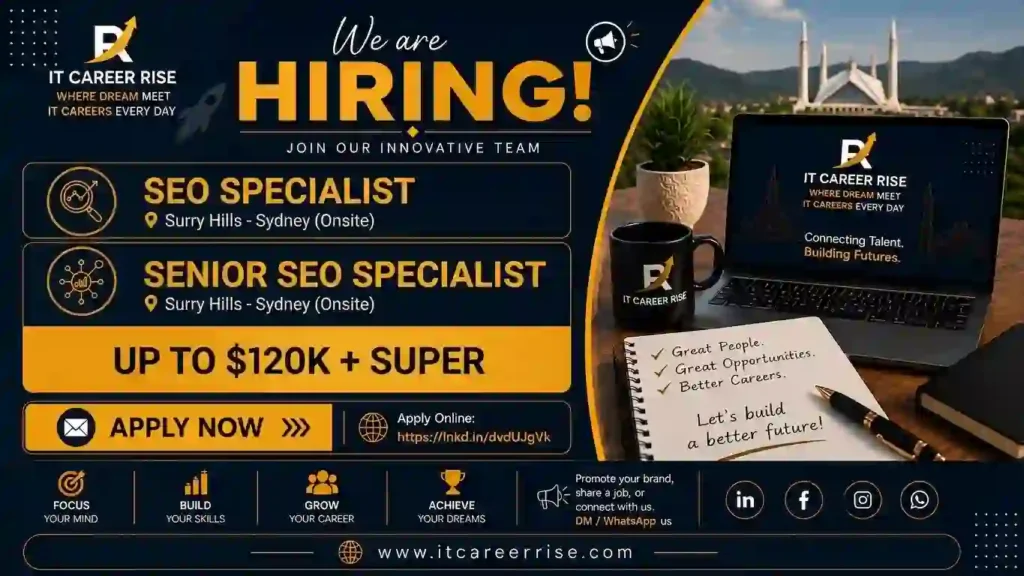

Sydney’s search marketing scene is hiring again, and this time the job description looks different. A well-regarded digital agency in Surry Hills is expanding its organic search team and has opened two roles at once: an SEO Specialist paying up to $100K + Super, and a Senior SEO Specialist paying up to $120K + Super, both with three days working from home each week.
What makes these SEO jobs in Surry Hills stand out is the mandate. You won’t only be chasing blue links. You’ll be working across traditional SEO, GEO (Generative Engine Optimisation) and AEO (Answer Engine Optimisation) — helping brands stay visible inside Google and inside AI-powered answer engines.
This guide breaks down the roles, the salary, the skills, the career path, and exactly how to apply.
Quick Overview: The Surry Hills SEO Roles at a Glance
If you’re scanning, here’s the short version.
Employer: A leading digital agency in Surry Hills, Sydney, hiring through Searchability® Roles open: SEO Specialist (up to $100,000 + Super) and Senior SEO Specialist (up to $120,000 + Super) Location: Surry Hills, Sydney NSW — hybrid, 3 days work from home per week Focus areas: Technical SEO, content and organic strategy, plus GEO and AEO Client work: A strong, varied portfolio of brands Apply to: Liam Harvey — liam.harvey@searchability.com.au or 0480 546 593 (contact: Kate Donoghue, Searchability®)
Both positions sit inside the same growing team, which means the agency is building capability rather than backfilling. That usually signals budget, client demand, and room to progress.
What Does an SEO Specialist Do?
An SEO Specialist improves how a website performs in organic search. They research keywords, fix technical issues that block crawling and indexing, optimise on-page content, build authority through links and digital PR, and report on rankings, traffic and revenue. In agency settings, they do this across several client accounts at the same time.
That’s the snippet-friendly answer. Here’s what the day actually looks like.
Core Responsibilities of an SEO Specialist
- Keyword research and strategy — mapping search demand to pages, spotting gaps competitors have missed, and building topic clusters instead of isolated posts.
- Technical SEO audits — crawl budget, indexation, site architecture, internal linking, Core Web Vitals, structured data, redirects, canonicals, JavaScript rendering.
- On-page SEO — titles, headings, entity coverage, internal links, semantic depth, and matching content format to search intent.
- Off-page SEO — link building strategy, digital PR, brand mentions, and monitoring the backlink profile for risk.
- Content strategy for SEO — briefing writers, editing for expertise and clarity, refreshing decaying pages.
- Measurement — Google Search Console, GA4, rank tracking, and translating all of it into client-friendly reporting.
If you want a look at how similar responsibilities are written up locally, this Local SEO Specialist job breakdown covers the day-to-day duties in plain language, and this SEO Specialist role at Shape Solutions shows what employers list as must-have skills.
How the Senior SEO Specialist Role Is Different
The Senior SEO Specialist position at up to $120K + Super carries the same craft, plus ownership. Expect to:
- Own the organic search strategy for larger or more complex accounts.
- Lead client conversations — presenting roadmaps, defending recommendations, and handling difficult performance discussions.
- Mentor junior specialists, review their audits, and raise the technical standard of the team.
- Solve the hard technical problems — migrations, international SEO, faceted navigation, large-scale templating issues.
- Shape the agency’s GEO and AEO approach, because almost nobody has a settled playbook yet.
In short: the Specialist executes brilliantly. The Senior Specialist decides what should be executed and can prove why.
What Is Generative Engine Optimisation (GEO)?
Generative Engine Optimisation (GEO) is the practice of optimising content so it gets retrieved, cited and summarised by AI systems that generate answers — such as Google’s AI Overviews, ChatGPT, Perplexity, Gemini and Copilot. Instead of competing only for a ranking position, GEO competes to become the source the AI quotes.
That’s the 45-word version worth memorising for interviews.
GEO matters because the click no longer always happens. When a generative engine answers the question directly, visibility means being inside the answer. Practical GEO work includes:
- Writing clear, extractable statements that an AI can lift without ambiguity.
- Strengthening entity clarity — making it obvious who you are, what you do, and how you relate to other known entities.
- Building citation-worthy assets: original data, expert commentary, first-hand experience, and genuinely useful explanations.
- Maintaining consistency across the web, since generative systems triangulate facts from many sources.
- Structuring pages so meaning survives being chopped into chunks and re-assembled by a retrieval system.
Google’s own Search Essentials documentation still forms the foundation here — helpful, people-first content remains the base layer that GEO sits on top of.
What Is Answer Engine Optimisation (AEO)?
Answer Engine Optimisation (AEO) is the practice of formatting content so search and AI systems can extract a direct, correct answer to a specific question. It focuses on concise definitions, question-based headings, structured data, and clean formatting that machines can parse without guessing.
AEO is narrower and more tactical than GEO. Where GEO asks “will an AI trust and cite us?”, AEO asks “can a machine find the exact answer on this page in under two seconds?”
Core AEO techniques:
- Use the question as the heading, then answer it immediately in 40–60 words.
- Put the answer before the elaboration, never after.
- Apply structured data — FAQPage, HowTo, Article, and for job listings, JobPosting. The reference standards live at Schema.org.
- Keep sentences short and unambiguous. Pronouns and clever phrasing hurt extraction.
- Cover the follow-up questions on the same page so the engine doesn’t need to leave.
SEO vs GEO vs AEO: The Difference, Explained Simply
Rather than a table, think of it as three layers of the same building.
SEO is the foundation: crawlability, indexation, relevance, authority, and ranking in a list of results.
AEO is the formatting layer: shaping information so an engine can pull out a precise answer for a precise question.
GEO is the trust layer: becoming the source that a generative system chooses to synthesise and cite when it composes an original answer.
You cannot do GEO or AEO well without solid SEO underneath. That’s exactly why this Surry Hills agency wants specialists who are already strong in technical SEO and content — the AI layers are additions, not replacements.
Why These Surry Hills SEO Jobs Matter Right Now
Surry Hills has quietly become one of Sydney’s densest clusters of creative and digital agencies. It sits minutes from Central Station, walking distance from the CBD, and is packed with studios, media agencies and independent performance shops. For an SEO career, proximity matters: you meet more people, you hear about more roles, and you learn faster.
Three reasons these particular roles are worth a serious look:
1. You get portfolio breadth. Agency life means multiple industries, multiple CMS platforms, and multiple problem types in a single quarter. In-house roles go deep; agency roles go wide. Early and mid-career, width compounds faster.
2. You get to work at the edge. Most Australian teams are still debating whether GEO and AEO are real. This team is already resourcing for it. Being one of the first specialists in a market with a genuine AI-search skill set is a rare career position to hold.
3. The hybrid model is genuinely flexible. Three days working from home per week is above the Sydney average for agency roles, where two days is more common. That’s roughly 60% of your week without a commute.
If you’re weighing up hybrid versus fully remote setups, this guide on landing your first remote job covers how to evaluate flexibility offers properly.
SEO Specialist Salary in Sydney: What the Numbers Really Say
A mid-level SEO Specialist in Sydney typically earns between AU$80,000 and AU$105,000 plus superannuation, while a Senior SEO Specialist generally earns AU$105,000 to AU$130,000 plus super. Team leads and SEO Managers commonly range from AU$130,000 to AU$160,000 plus super, depending on agency size and client portfolio.
The Surry Hills roles sit right in the healthy part of those bands:
- SEO Specialist — up to $100,000 + Super: at or slightly above market for a strong mid-level candidate.
- Senior SEO Specialist — up to $120,000 + Super: competitive for an agency senior with technical depth.
Don’t Forget the Super
Australian employers pay superannuation on top of the advertised salary. At the current superannuation guarantee rate of 12%, the packages work out roughly as follows:
$100,000 + super ≈ $112,000 total package $120,000 + super ≈ $134,400 total package
That’s why Australian job ads say “+ Super” so prominently, and why comparing an Australian salary to an overseas one without adding super understates the offer. The Australian Taxation Office superannuation guarantee page is the authoritative source if you want to confirm the current rate before you negotiate.
How Sydney Compares Nationally
Sydney and Melbourne sit at the top of the Australian SEO pay scale, with Brisbane a step behind, and Perth, Adelaide, Canberra and the Gold Coast typically 5–15% lower for equivalent roles. Remote SEO jobs in Australia often anchor to a national rather than Sydney rate, which is worth knowing before you assume remote automatically pays the same.
Skills You Need to Be an SEO Specialist in 2026
In 2026, an SEO Specialist needs technical SEO fundamentals, keyword and intent research, content strategy, data analysis in GA4 and Search Console, structured data implementation, and a working understanding of how AI search systems retrieve and cite sources. Communication and client presentation skills separate good specialists from great ones.
Let’s break that down.
Technical SEO Skills
- Crawling and indexation control — robots.txt, meta robots, canonical tags, XML sitemaps.
- Site architecture and internal linking at scale.
- Core Web Vitals and page experience diagnostics.
- Structured data and schema markup implementation.
- JavaScript rendering issues and how to diagnose them.
- Site migrations, redirect mapping, and international hreflang setups.
- Log file analysis for large sites.
Content and On-Page Skills
- Search intent classification and SERP analysis.
- Topical mapping and semantic keyword coverage.
- Writing and editing briefs that produce genuinely useful pages.
- Content refresh and pruning strategy for decaying pages.
- E-E-A-T signals: author bios, credentials, citations, first-hand experience.
If content is your stronger side, content writing career paths shows how writing and SEO increasingly overlap into a single hybrid skill set.
Off-Page and Authority Skills
- Link building strategy that survives scrutiny.
- Digital PR and outreach.
- Backlink profile auditing and disavow judgement.
- Brand entity building across the wider web.
AI-Era Skills (The Differentiator)
- Understanding retrieval-augmented generation at a conceptual level.
- Writing extractable, citation-ready content blocks.
- Monitoring brand visibility inside AI answers, not just rankings.
- Using LLMs responsibly for research, clustering and QA — while keeping human judgement in the loop.
- Explaining GEO and AEO to clients who’ve only ever heard of “ranking number one.”
Tools You’ll Actually Use
Google Search Console, Google Analytics 4, Screaming Frog, Ahrefs or Semrush, Looker Studio, and increasingly, AI visibility trackers. A little SQL, Python or spreadsheet automation puts you ahead of most applicants. Basic CMS fluency matters too — plenty of SEO fixes land in WordPress, and this WordPress development career guide explains how much technical depth is realistically useful for a marketer.
Job Scope and Market Demand for SEO Roles
The interesting thing about the current SEO job market is the shape of demand rather than its size. Generic, execution-only SEO roles are getting squeezed, because a lot of routine output can now be produced faster. Meanwhile, demand for specialists who can do the following is rising:
- Diagnose and fix complex technical problems on large sites.
- Prove commercial impact rather than ranking movement.
- Adapt strategy for AI-driven search surfaces.
- Communicate confidently with senior stakeholders.
That barbell pattern shows up across the market. Junior roles are competitive; genuinely senior, strategic roles are hard to fill. Which is precisely why an agency is advertising a Specialist and a Senior Specialist together — they need the execution engine and the strategic head at once.
Related demand is strong across the wider discipline too. If you’re comparing paths, browse digital marketing job trends, social media marketing roles, and data analyst opportunities — analytics skills increasingly overlap with senior SEO work.
Is SEO Still Relevant Now That AI Search Is Growing?
Yes. SEO remains relevant because AI search systems still retrieve information from indexed web pages. Generative engines summarise sources rather than replacing them, so crawlable, authoritative, well-structured content is a prerequisite for appearing in AI answers. What is changing is the measurement of success — from rankings and clicks toward citations, brand mentions and assisted conversions.
The honest picture: zero-click behaviour is increasing, so raw traffic for informational queries is under pressure. But commercial and transactional queries still send clicks, brand visibility inside AI answers still drives demand, and every AI system needs a source. Someone has to be the source. That’s the job.
The specialists who struggle are those who defined their value as “I move keywords up a list.” The ones thriving define it as “I make brands findable and trusted wherever people search.”
Why Choose ROZGAR
If you’re hunting for roles like these — in Sydney, across Australia, or closer to home — you need a job platform that filters noise instead of adding to it.
Here’s why choose ROZGAR:
- Verified, current listings. Roles are checked and dated, so you’re not applying to a vacancy that closed six months ago.
- Clear, honest job descriptions. Salary, location, work model and requirements written in plain English, not corporate fog.
- Career guides alongside vacancies. Every listing sits next to practical advice on how to actually get hired for it.
- Organised by category and city. Filter by digital marketing jobs, online jobs, city-wise jobs, or latest jobs.
- Built for real career progression, not just one-off applications.
Explore Advanced Jobs at ROZGAR
Ready to widen the search? Explore advanced jobs at ROZGAR and start with these high-demand areas:
- Digital marketing roles and openings
- Content writer and copywriting jobs
- Remote and online job listings
- In-demand IT jobs and onsite opportunities
- Digital marketing internships for beginners
- Junior WordPress developer positions
How to Learn SEO, GEO and AEO (Free and Paid Resources)
You do not need a degree to work in SEO. You need demonstrable capability. Here’s a realistic learning path.
Free Resources Worth Your Time
- Google Search Central documentation — the primary source. Read the SEO Starter Guide and Search Essentials properly, not skimmed.
- Google Search Console Help — learn to interpret the reports before you learn to interpret third-party tools.
- Schema.org — the vocabulary reference for structured data, essential for AEO work.
- Moz Beginner’s Guide to SEO — still one of the clearest free foundations available.
- Ahrefs blog and YouTube channel — practical, tested, and generous with free material.
- web.dev by Google — for Core Web Vitals and performance fundamentals.
Paid Courses and Certifications
- Google Digital Marketing & E-commerce Professional Certificate on Coursera — broad marketing grounding with a recognisable credential.
- IBM SkillsBuild — free and low-cost courses in AI fundamentals and data skills, which pair unusually well with modern SEO.
- Semrush Academy and HubSpot Academy — free certifications that look fine on a CV and teach real tool workflows.
- Technical SEO training from specialist providers if you want to move into migrations and enterprise work.
The Part That Actually Gets You Hired
Build something. Launch a site on a topic you know, rank it, break it, fix it. Document what happened. In interviews, one honest story about diagnosing a traffic drop beats five certificates.
Then add an AI-search dimension: track whether your pages get cited in AI Overviews or by Perplexity, and record what changed when you restructured a page. Almost no candidate is doing this yet. It’s an enormous differentiator right now.
If you’re starting from zero, freelance career trends is a useful read — freelance SEO projects are still the fastest way to build a portfolio before you apply for agency roles.
Real-World Examples: What This Work Looks Like in Practice
Abstract advice is easy to nod at and hard to use. Three concrete scenarios you’d genuinely encounter in a Surry Hills agency role:
Example 1 — The e-commerce indexation problem. A retail client’s faceted navigation is generating hundreds of thousands of near-duplicate URLs. Crawl budget is being burned on filter combinations nobody searches for, while genuine category pages sit unindexed. The fix involves canonical logic, parameter handling, selective noindexing, and a rebuilt internal linking structure. Revenue impact arrives within a quarter. This is classic Senior SEO Specialist territory.
Example 2 — The AI Overview capture. A financial services client is losing informational traffic to AI Overviews. Rather than fighting it, you restructure their explainer content: question-based H2s, 45-word direct answers under each, FAQ schema, named expert authors with real credentials, and original data nobody else has. Three months later, the brand is being cited in the AI answer rather than buried beneath it. Clicks are lower; qualified enquiries are up. That’s GEO and AEO working together.
Example 3 — The migration nobody wants to own. A client is replatforming. Without careful redirect mapping, template-level SEO requirements, and pre-launch staging audits, they’ll lose a meaningful share of organic revenue overnight. The specialist who can run a migration calmly is the specialist who gets promoted.
Notice the pattern. In all three cases the value comes from diagnosis and judgement, not from producing more content.
Future Career Opportunities: Where SEO Leads Next
SEO is one of the better-connected disciplines in marketing, because it touches content, engineering, analytics and commercial strategy at once. Typical progressions from a Senior SEO Specialist role:
- SEO Manager / Team Lead — owning a team, a P&L contribution, and client relationships.
- Head of Organic / Head of SEO — setting agency-wide methodology and standards.
- Organic Growth or Performance Director — SEO plus paid, plus CRO, plus lifecycle.
- Technical SEO Consultant — high day rates, enterprise migrations, and deep specialisation.
- In-house Search Lead — one brand, deep ownership, often better work-life balance.
- GEO / AI Search Strategist — a title that barely existed two years ago and is becoming a genuine specialism.
- Independent consultant or agency founder — the path many senior specialists eventually take.
The AI-search specialisation deserves emphasis. Every brand is currently asking the same question: “How do we show up when the answer is generated, not listed?” Very few people can answer it credibly. If you take one of these Surry Hills roles and spend two years building that expertise on real client accounts, you will be exceptionally employable in 2028.
How to Apply for the Surry Hills SEO Jobs
These roles are being recruited through Searchability®, a specialist technology and digital recruitment agency operating in Australia and the UK. You can review their business at searchability.com.au.
To apply, contact Liam Harvey directly:
Email: liam.harvey@searchability.com.au Phone: 0480 546 593 Also listed: Kate Donoghue, Searchability® Roles: SEO Specialist (up to $100K + Super) and Senior SEO Specialist (up to $120K + Super) Location: Surry Hills, Sydney — 3 days WFH per week
How to Make Your Application Stand Out
- Say which role you’re applying for. Two positions are open. Don’t make the recruiter guess.
- Lead with an outcome, not a duty list. “Recovered 62% of organic sessions after a failed migration” beats “responsible for SEO.”
- Show technical depth early. Name the audits you’ve run and the problems you’ve solved.
- Address the GEO/AEO angle explicitly. Even a paragraph on what you’ve tested puts you ahead of most applicants.
- Keep the CV to two pages and make the first third do the heavy lifting.
- Follow up once, politely, after a week. Recruiters are busy, not uninterested.
If your CV needs work before you send it, these application guides cover the fundamentals of structuring a professional application that gets read.
Frequently Asked Questions
What does an SEO Specialist do?
An SEO Specialist improves a website’s visibility in organic search results. They conduct keyword research, run technical audits, optimise on-page content, build authority through links and digital PR, and report on organic traffic, rankings and revenue. In agencies, they manage several client accounts simultaneously.
What is the difference between SEO, GEO and AEO?
SEO improves ranking in traditional search results. AEO formats content so engines can extract a direct answer to a specific question. GEO optimises content so generative AI systems retrieve, trust and cite it inside AI-generated answers. GEO and AEO build on SEO foundations rather than replacing them.
How much does a Senior SEO Specialist earn in Sydney?
A Senior SEO Specialist in Sydney typically earns between AU$105,000 and AU$130,000 plus superannuation. The Surry Hills role advertises up to AU$120,000 plus super, which equates to roughly AU$134,400 as a total package at the 12% superannuation guarantee rate.
What skills do you need to be an SEO Specialist in 2026?
You need technical SEO (crawling, indexation, Core Web Vitals, structured data), keyword and search-intent research, content strategy, analytics in GA4 and Google Search Console, link building strategy, and an understanding of how AI search systems retrieve and cite content. Strong communication is essential in agency roles.
Is SEO still relevant with AI search growing?
Yes. AI search systems retrieve information from indexed web pages, so crawlable, authoritative content remains a prerequisite for appearing in AI answers. The discipline is shifting from ranking-focused measurement toward citations, brand visibility and assisted conversions, but the underlying work remains essential.
What qualifications are needed for an SEO job?
No formal qualification is required. Most employers prioritise demonstrable experience, a portfolio of results and tool proficiency. Degrees in marketing, communications or computer science help, and certifications from Google, Coursera, Semrush or HubSpot support entry-level applications.
How many days of work from home do Sydney SEO jobs typically offer?
Most Sydney agency SEO roles offer two to three days of work from home per week. The Surry Hills SEO Specialist and Senior SEO Specialist roles offer three days WFH, which is at the more flexible end of the current Sydney market.
How do I apply for SEO jobs in Sydney?
Apply directly through the recruiter or agency listing. For these Surry Hills roles, email liam.harvey@searchability.com.au or call 0480 546 593, stating which of the two positions you’re applying for and including a CV that leads with measurable SEO outcomes.
Conclusion: Two Roles, One Very Good Moment to Move
Search is going through its biggest structural change since mobile-first indexing. Most SEO professionals are watching it happen. A smaller group is being paid to work on it.
These Surry Hills roles put you in the second group. SEO Specialist up to $100K + Super. Senior SEO Specialist up to $120K + Super. Three days WFH. A strong client portfolio. And a genuine mandate to build GEO and AEO capability rather than just talk about it.
If you’re already working in SEO and you want your next two years to compound into a rare, defensible skill set, this is a well-timed move. Send your CV to liam.harvey@searchability.com.au or call 0480 546 593 and say which role you’re going for.
And if you’re building toward a role like this rather than ready to apply today, start where the opportunities are listed and explained.
👉 Book your seat with Advanced Jobs at ROZGAR — explore verified digital marketing vacancies, remote and online roles, and practical career guides that help you get hired, not just apply.
Your next role is out there. Go and make yourself the obvious candidate for it.